The Story Behind Kvikk Lunsj
Norway’s Favourite Hiking Chocolate
If you spend even a few days in Norway, you’ll quickly notice one chocolate appears everywhere. In backpacks. At mountain summits. On cross-country ski trips. In cabin kitchens. Even tucked into jacket pockets waiting for a well-earned coffee break.
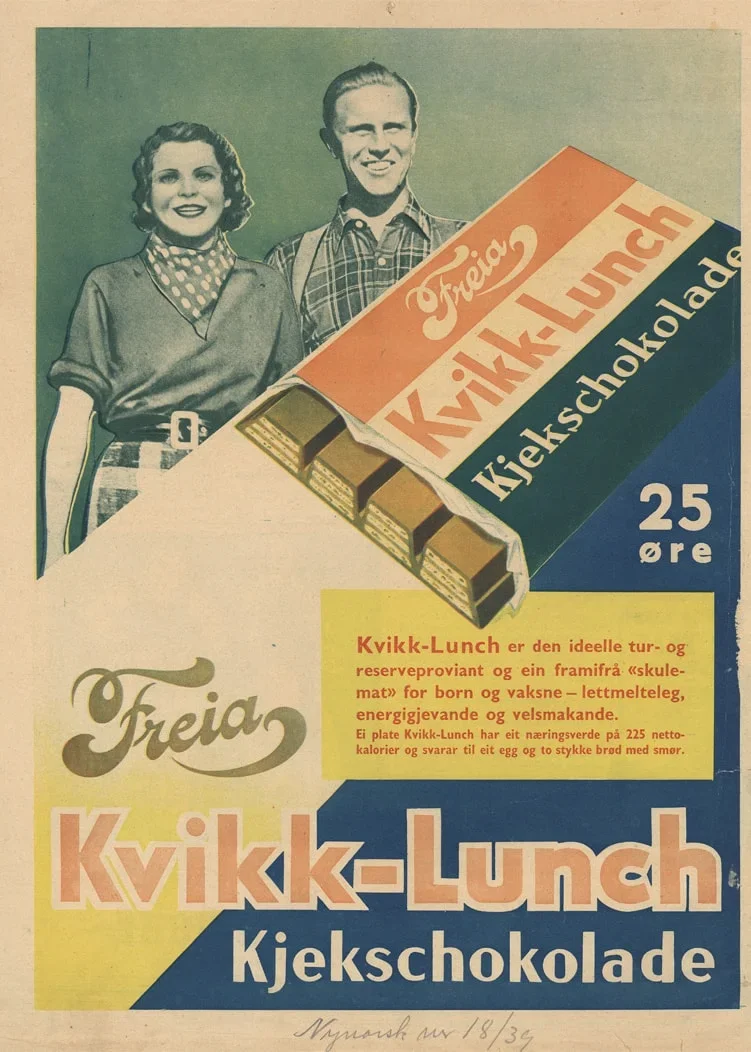
That chocolate is Kvikk Lunsj.
For Norwegians, Kvikk Lunsj isn’t simply a chocolate bar. It’s part of the country’s outdoor culture. Whether you’re hiking in Lofoten, skiing across Hardangervidda or enjoying a sunny day by the sea, chances are someone nearby is unwrapping those familiar four fingers of milk chocolate and wafer.
At KOS Lofoten, we’re surrounded by some of Norway’s most spectacular hiking trails, so naturally, Kvikk Lunsj has become part of everyday life here too. If you’re heading up Fløya, walking to Fiskarkona, exploring Svinøya or joining one of our guided adventures, don’t be surprised if you see people carrying one.
What is Kvikk Lunsj?
Kvikk Lunsj (which literally means “Quick Lunch”) is a chocolate-covered wafer bar made by Freia. It consists of four crisp wafer fingers coated in smooth Norwegian milk chocolate.
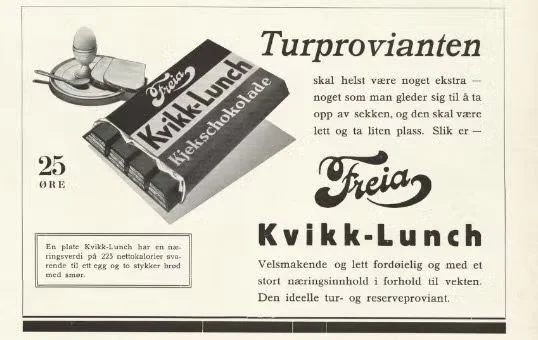
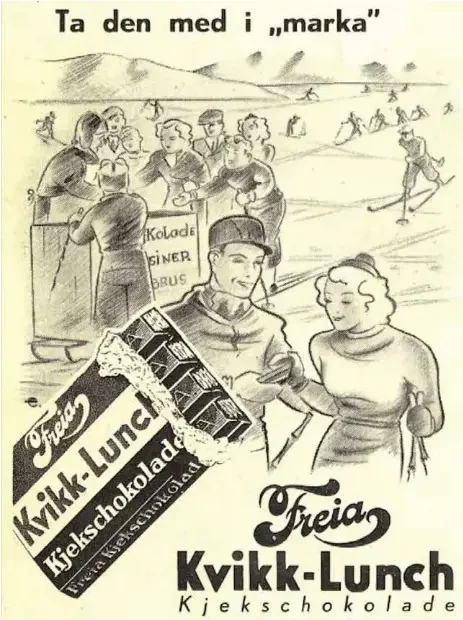
It was first introduced in 1937, originally as an energy-rich snack designed specifically for people spending time outdoors. The shape made it easy to carry in the pockets of the new anoraks that were becoming popular at the time, and advertising focused on it being ideal “tour food.”
Today it has become affectionately known as Norway’s hiking chocolate or tursjokolade.
Why is Kvikk Lunsj so popular?
Many countries have iconic snacks.
Italy has gelato.
Britain has fish and chips.
America has peanut butter.
Norway has Kvikk Lunsj.
It isn’t because it’s impossible to find better chocolate. It’s because it has become woven into Norwegian traditions.
Almost every Norwegian grows up eating Kvikk Lunsj while:
Hiking in the mountains
Skiing during Easter
Visiting mountain cabins
Taking school trips
Enjoying outdoor lunches
Climbing peaks
Drinking coffee beside a campfire
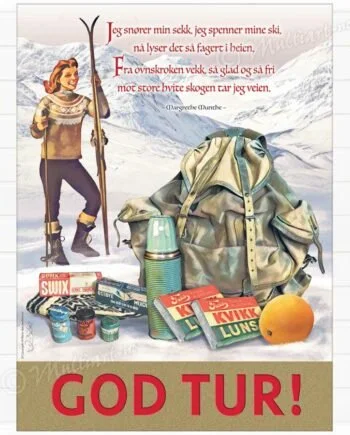
For many families, coffee, an orange and a Kvikk Lunsj are the classic Norwegian hiking lunch.
Why do Norwegians eat Kvikk Lunsj at Easter?
If you visit Norway during Easter (Påske), you’ll see supermarket shelves stacked floor to ceiling with Kvikk Lunsj.
That’s because Easter isn’t only about chocolate eggs in Norway.
It’s about getting outdoors.
Millions of Norwegians head to mountain cabins for skiing and hiking, making Easter one of the biggest outdoor holidays of the year. Kvikk Lunsj became closely linked with these traditions through decades of clever marketing and genuine popularity, to the point where many people can’t imagine a mountain trip without one.
Kvikk Lunsj vs KitKat: What’s the difference?
This is probably the question tourists ask most.
Which came first?
KitKat came first.
The original product was introduced in Britain in 1935 (originally called Rowntree’s Chocolate Crisp), while Kvikk Lunsj arrived in Norway in 1937.
Is Kvikk Lunsj a copy?
Inspiration certainly came from Britain.
According to the history of Freia, Johan Throne Holst developed a similar product for the Norwegian market after contacts with the British manufacturer. The recipe was adapted for Norwegian tastes and marketed specifically as outdoor food rather than everyday confectionery.
Do they taste the same?
Most Norwegians will tell you absolutely not.
The biggest differences are:
Freia milk chocolate has a richer, creamier flavour.
The wafer texture is slightly different.
Kvikk Lunsj is generally considered less sweet.
The recipe has remained remarkably consistent for almost 90 years.
Ask a Norwegian whether KitKat and Kvikk Lunsj are the same, and prepare for a passionate discussion!
The famous green, yellow and red wrapper
The distinctive wrapper has become almost as iconic as the chocolate itself.
Many hikers joke that if you see those colours sticking out of someone’s backpack, they’re probably Norwegian.
Interestingly, the colours also resemble the painted trail markers you’ll find across Norway, where red T symbols and brightly marked routes guide hikers safely through the mountains. While the wrapper wasn’t officially designed to copy hiking trail markings, its colours have become closely associated with outdoor adventures and are instantly recognisable on any trail.
The hiking rules hidden inside the wrapper
One of the most unique features of Kvikk Lunsj is found inside the wrapper.
Instead of advertising, you’ll often discover Norway’s famous Fjellvettreglene, the Norwegian Mountain Code.
These safety rules encourage hikers to:
Plan your trip.
Adapt to the weather.
Carry proper equipment.
Know your route.
Turn back if necessary.
Look after yourself and others.
Millions of visitors discover these mountain safety messages simply by opening a chocolate bar. Since the 1960s, Kvikk Lunsj has also featured hiking tips, tourist information and mountain safety advice, strengthening its connection with Norway’s outdoor culture.
Fun facts about Kvikk Lunsj
It first appeared in 1937.
The very first version was actually covered in dark chocolate, before switching to milk chocolate.
Production stopped during parts of World War II because of ingredient shortages.
During the 1952 Oslo Winter Olympics, around 10 million Kvikk Lunsj bars were sold.
It has become one of Norway’s strongest and most recognisable brands.
Try one while exploring Lofoten
Some traditions simply make more sense when you’re here.
Walk across the bridge to Svinøya.
Grab a freshly brewed coffee from KOS Lofoten.
Pick up a Kvikk Lunsj.
Then head for Fløya, Fiskarkona or one of the many spectacular viewpoints around Svolvær.
After all, there’s something very Norwegian about reaching the summit, sitting on a rock overlooking the sea, opening a chocolate bar and taking a moment to enjoy the view.
That first bite somehow tastes even better after you’ve earned it.
If you’d like to discover more of Lofoten’s hiking culture, ask us about local walking routes or join one of the guided adventures with Lofoten Insight. We’ll even tell you where the best coffee stop is afterwards.